The Pitfalls of Using Claude, or Claude + Playwright, for SAP Testing: An Objective Comparison With Tosca, Worksoft, UFT One and ACCELQ (2026)
What really happens when an SAP program swaps its test automation tool for Claude, Claude Code and Playwright: the four patterns, where each one works, ten pitfalls from test data management to SAP GUI coverage, the research on test maintainability and self-healing, audit evidence, SAP’s 2026 API policy and the real cost at regression scale, and a side-by-side comparison with Tricentis Tosca, Worksoft, OpenText Functional Testing (UFT One), ACCELQ and SAP’s own tooling.

Every SAP test lead has now sat through the demo. Someone opens Claude Code, types “test the sales order flow in Fiori,” and a few minutes later a Playwright script logs in, creates an order and goes green. The next slide compares the cost of that script, close to zero, with the renewal quote for the commercial test tool. It is a persuasive demo, and it is changing how SAP programs buy test automation: some are pausing renewals, some are cancelling tool evaluations, and some are telling their system integrator to “just use AI.”
This guide asks what happens after the demo. It looks at the four ways teams actually use Claude for SAP testing, where each works well, and the ten places it tends to fail on a real SAP landscape: test data first, then SAP GUI coverage, UI5 locators, end-to-end chains, false passes, audit evidence, security, SAP’s 2026 API policy, cost at regression scale and ownership. It then goes deep on the research into test maintainability and self-healing, because that is where automation programs are won or lost, and compares the approach, objectively, with Tricentis Tosca, Worksoft, OpenText Functional Testing (formerly UFT One), ACCELQ and SAP’s own tooling. It is current to November 3, 2026, and every claim is sourced.
One note on framing. Claude is a capable model, and Playwright is an excellent open-source browser framework. The question here is not whether they are good. It is whether, together, they cover what SAP regression testing needs: the systems, the data, the evidence and the people.
Disclosure: Matt Angerer, who runs The Sign-Off Table, works at ACCELQ, one of the tools compared in this guide. To keep the comparison fair, every tool, ACCELQ included, is described only from its own documentation and independent sources, with weaknesses alongside strengths, and ACCELQ’s own approach appears in one clearly marked section near the end. Anthropic, SAP and the other vendors did not review this guide, and ACCELQ does not sponsor or review this site. Read the full disclosure.
Key takeaways
- Where the model sits decides almost everything. Claude writing Playwright code that a person reviews is a workable pattern for Fiori and APIs. Claude driving SAP at run time, through Playwright MCP or computer use, is exploration, not regression evidence.
- Test data management is the biggest gap. SAP tests consume documents, depend on valid org and master data, open periods, stock and credit, and collide in shared QA clients. Playwright’s own docs say to control your data; Claude and Playwright give you nothing to do that with.
- Playwright cannot drive SAP GUI for Windows or SAP Business Client. Claude computer use can see them, but Anthropic documents missed clicks and assumed successes, and there is no published SAP benchmark.
- Fiori and UI5 are reachable but fragile without UI5-aware locators and waits. The open-source libraries that add them are community projects with small maintainer bases.
- AI-generated tests can compile, pass and still assert nothing. One study measured 100% coverage with a 4% mutation score; SAP’s own architecture team saw an agent’s self-test pass a blank page.
- Maintenance, not creation, is where automation lives or dies. Research puts locators behind about three-quarters of web test breakages and async waits behind about half of flaky UI tests. Self-healing measurably cuts those false alarms, but in a 2026 study an LLM repair loop’s success fell from 70% to 50% once weakened assertions and deleted tests were counted. Heals need review.
- On API version 2026-10-21, Claude rejects temperature and other sampling parameters, models retire on about 60 days’ notice, and SAP’s 2026 API policy restricts autonomous AI agents calling SAP APIs. Each complicates SOX and GxP evidence.
- The commercial tools are not a free pass either: they are expensive, proprietary and partly reliant on SAP GUI Scripting too. Use the five gates in this guide to decide, scope by scope.
Why everyone is asking this now
Three things converged in 2025 and 2026. First, Playwright shipped test agents. Since version 1.56 it has a planner that explores an app and writes a test plan, a generator that turns the plan into Playwright tests while checking selectors against the live app, and a healer that repairs failing tests[1]. One command installs them as Claude Code agent definitions. Second, Microsoft’s Playwright MCP server lets an AI assistant drive a browser step by step through structured page snapshots[2]. Third, Anthropic’s computer use tool became generally available, letting Claude operate a desktop from screenshots[22].
Put together, they make it look as if a coding assistant can now do what a six-figure test platform does. The early published accounts are encouraging but thin. Microsoft’s Azure DevOps team converted more than 1,000 manual test cases into Playwright scripts with Copilot and an MCP server, and still found that vague test steps needed rewriting, visual checks weren’t possible, and engineers had to edit scripts by hand; it published no metrics[41]. The most detailed SAP-specific write-up I found, on automating SAP testing with OpenAI’s Codex CLI, covers OData, BAPI, Fiori through Playwright and SAP GUI scripting, reports no measured results, and positions the agent as a complement to commercial tools, not a replacement[40].
Four ways teams use Claude for SAP testing
“Use Claude for testing” means four different architectures, and they fail in different ways. The most important question about any of them is where the model sits: at authoring time, writing tests a person reviews, or at run time, deciding what to click and whether the result is a pass.
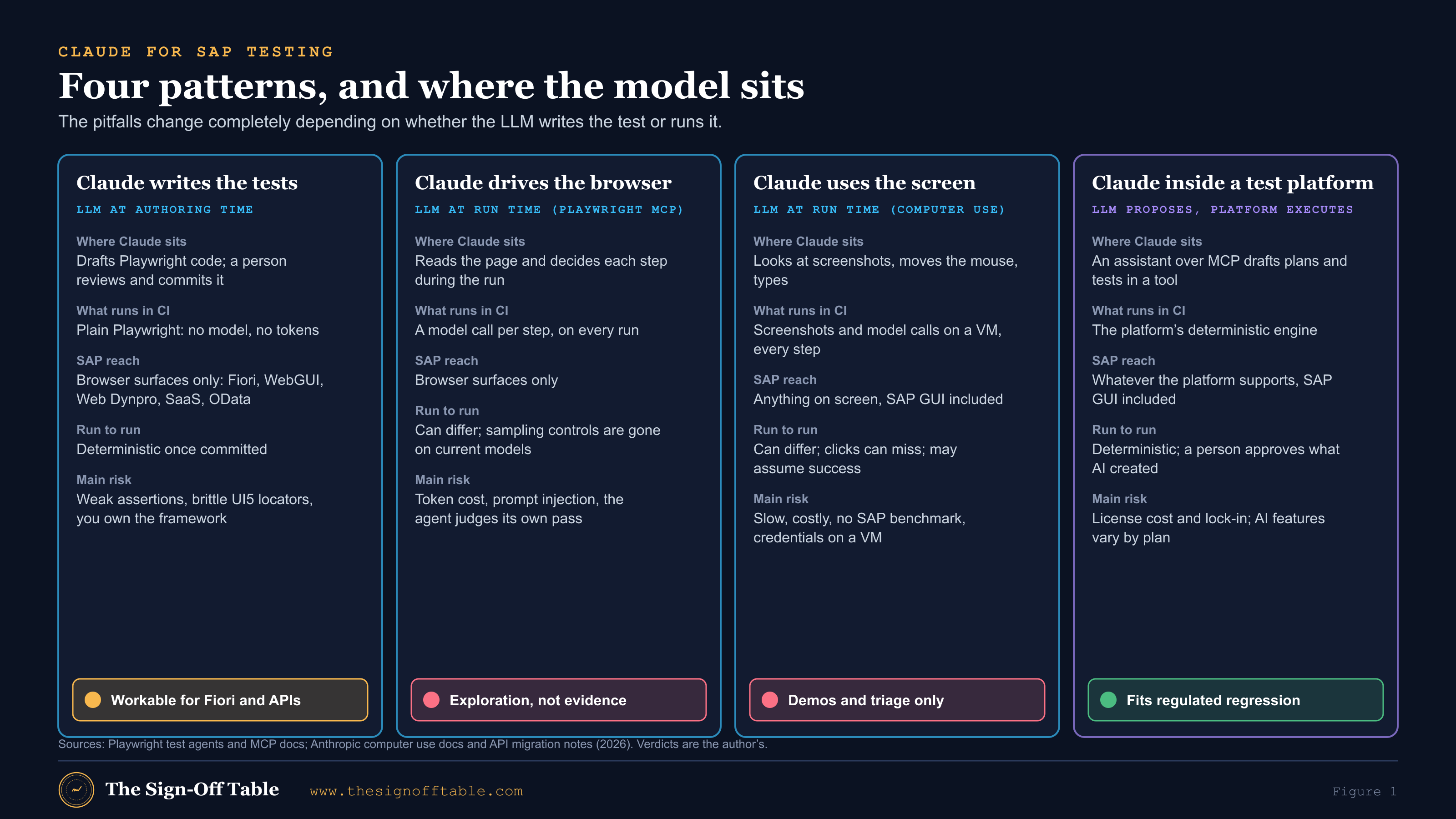
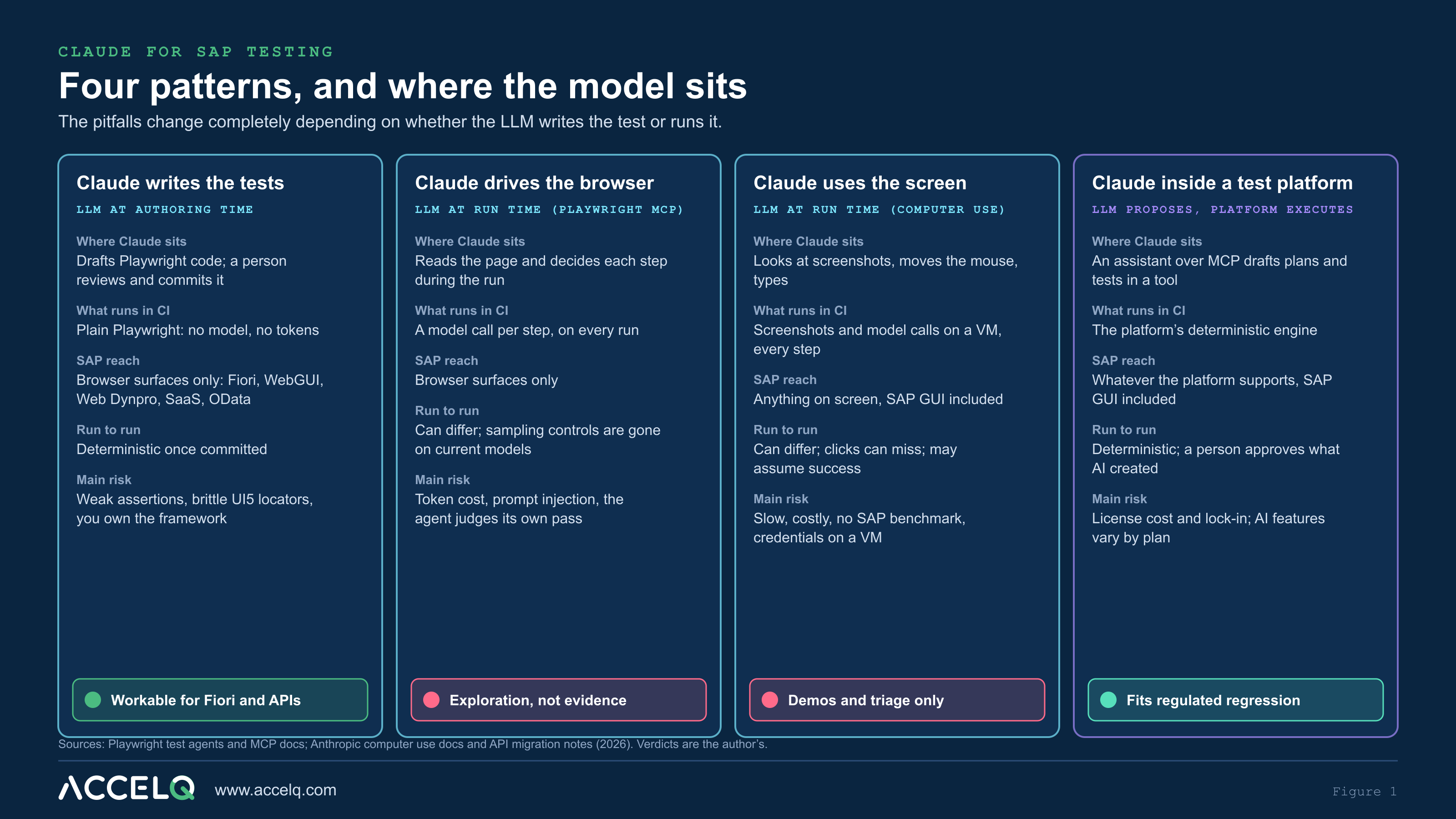
| Pattern | How it works | What runs in CI | Typical SAP use |
|---|---|---|---|
| 1. Claude writes the tests | Claude Code, or Playwright’s planner and generator, drafts Playwright tests; a person reviews and commits them[1] | Plain Playwright, with no model calls | Fiori, BTP and OData regression owned by engineers |
| 2. Claude drives the browser | Claude reads Playwright MCP page snapshots and chooses each action live[2] | A model call for every step of every run | Exploratory checks, triage, one-off verification |
| 3. Claude uses the screen | Claude computer use: screenshots in, mouse and keyboard out, on a VM[22] | Screenshots and model calls for every step | Anything visible, including SAP GUI; mostly demos |
| 4. Claude inside a test platform | An assistant drafts plans and tests through a vendor’s MCP server; the platform executes them[102],[131] | The platform’s own deterministic engine | Regulated regression with AI-assisted authoring |
Most of the pitfalls below bite hardest in patterns 2 and 3. Pattern 1 avoids run-time nondeterminism and token cost, but it inherits every limit of Playwright on SAP and makes you the owner of a framework. Pattern 4 is the one the commercial vendors are converging on, and it is the closest thing to a compromise.
Where Claude and Playwright genuinely work
Before the pitfalls, the fair case. There are SAP scopes where Claude-assisted Playwright is a sensible choice:
- Fiori and BTP apps your own developers build, with stable IDs set by design. UI5’s Test Recorder produces control locators other frameworks can use[12], and SAP’s own UI5 MCP server grounds Claude in current UI5 guidance[20].
- API tests. Playwright’s request fixture calls OData and REST services directly, reusing authenticated state[6]. These tests are deterministic, fast and cheap, and they don’t care how a screen renders.
- Scaffolding at authoring time. The generator checks selectors against the live app as it writes, and its output is a plain Playwright test that runs with no model and no tokens[1].
- Exploration and triage. An agent can walk a flow and report what it sees for a person to review. SAP’s Architecture Center found that once its agent had a browser through Playwright, it caught real usability problems the agent’s code-level checks had missed[21].
- Teams that already run a Playwright framework for their web estate, with engineers who will own it.
Notice what these have in common: browser or API surfaces, data you control, engineers who own the code, and the model kept out of the verdict. The pitfalls start where SAP stops looking like that.
Pitfall 1: test data management, the gap nobody demos
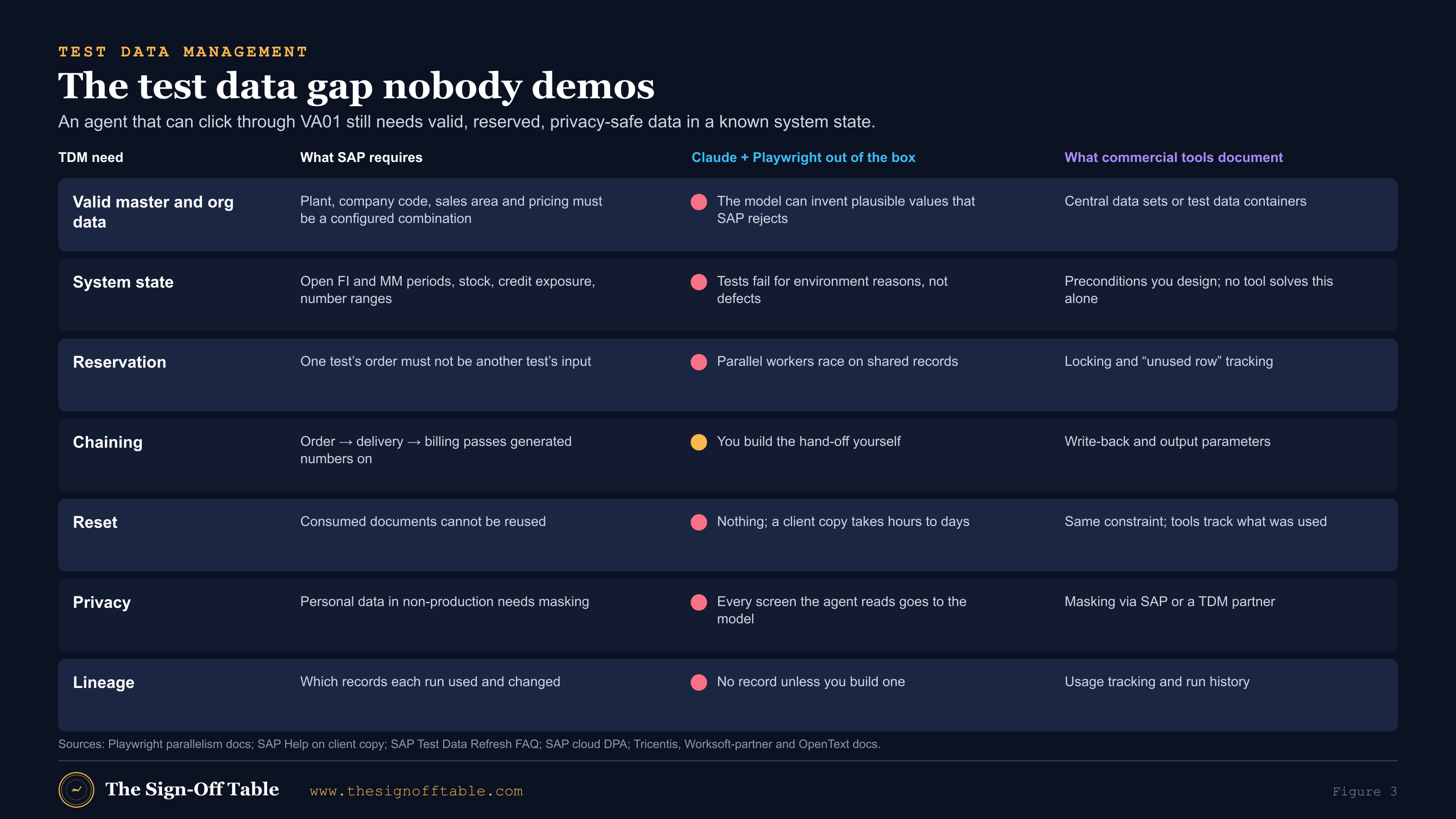
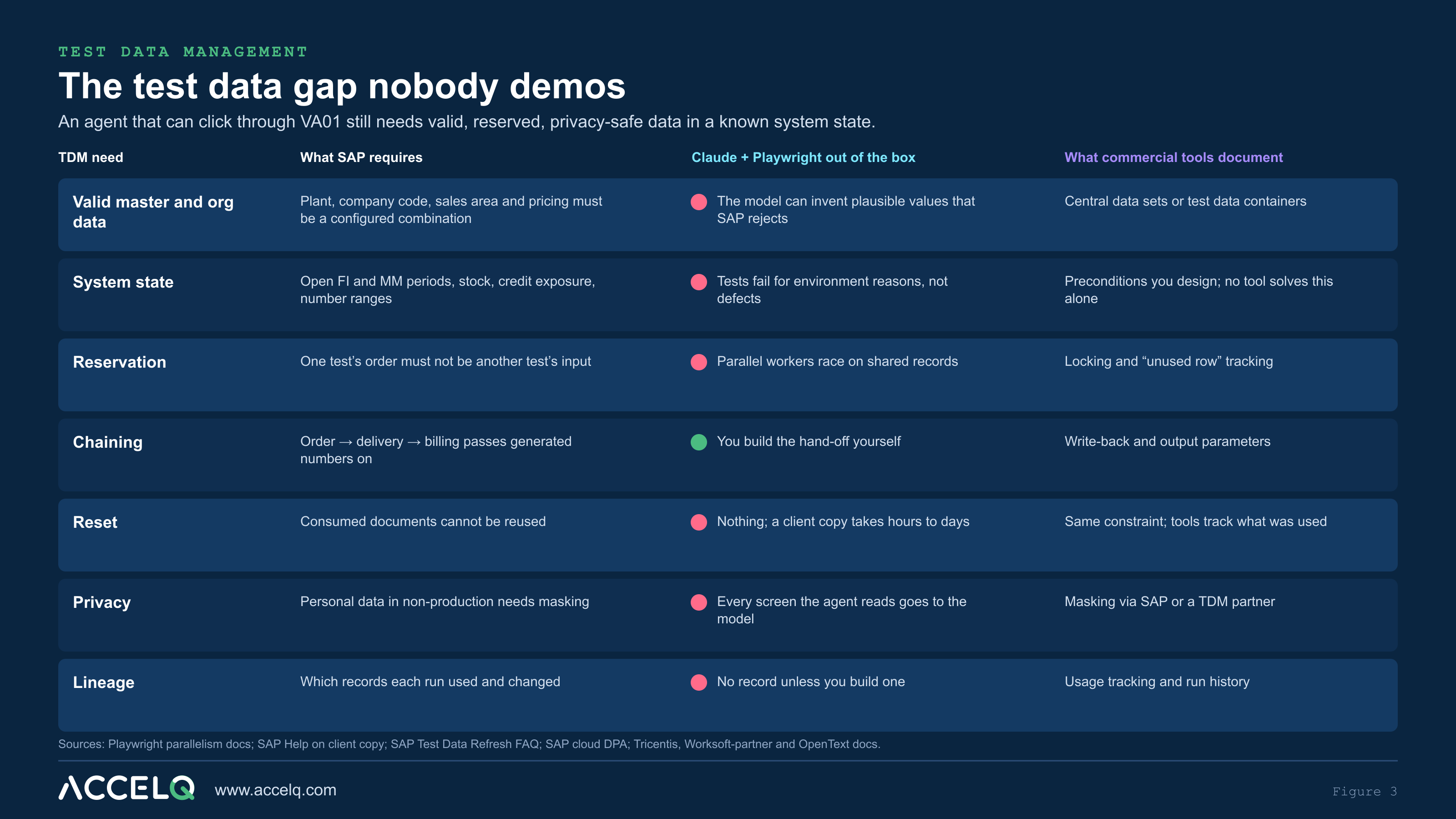
The demo always works because someone prepared the data. In an SAP regression suite, test data is the hardest part of the job, and it is the part Claude and Playwright do least to help with. Cross-industry, Capgemini and Sogeti found 76% of respondents spent a third of their time or more searching for, generating and managing test data[83]. In an SAP-specific survey sponsored by a test data vendor, 34% of 154 IT professionals named delays in provisioning test data as a significant challenge[84].
Why SAP test data is different
- Data must be a valid combination, not a valid value. A plant belongs to a company code, a sales area to a set of plants, a price to a condition record. An LLM can produce a material number, plant and sales area that each look right and together don’t exist. Code-generating LLMs invent non-existent package names at measurable rates[39]; nobody has measured the same for SAP org units, but the failure is the same kind.
- System state moves under you. Goods movements fail with M7053 when the posting date falls outside the open MM periods[79]. Each confirmed test order consumes available-to-promise stock[77]. Credit exposure builds until later orders block[76]. Buffered number ranges leave gaps, so document numbers can’t be predicted[78].
- Documents are consumed. Once a delivery is billed, that order line can’t be billed again. A regression suite needs a supply of fresh, valid inputs for every run.
- Data crosses systems. Decentralized EWM needs master data replicated from S/4HANA before a warehouse test can pass[80], and the same is true of Ariba, SuccessFactors and every other connected system.
What Claude and Playwright give you
Playwright runs tests in parallel workers that can’t coordinate, and its documentation is blunt: two tests that create or edit the same record “race with each other,” so you should never rely on another test having run first, and if you work with a database, “make sure you control the data”[3],[4]. In a shared SAP QA client, you don’t. Playwright isolates browser contexts, not server state, and SAP has no per-test rollback: a client copy can take “several hours or even days”[74], and SAP’s Test Data Refresh service for S/4HANA Cloud takes the quality system down for up to 24 hours, clears old test data and warns that scripts using static values will need adjusting[73].
Nothing in Claude or Playwright reserves a record, tracks which records a run consumed, hands a generated document number to the next step in a durable way, or records lineage for an auditor. You can build all of it. That is the point: you will be building a test data management layer, which is exactly what you were trying to avoid paying for.
What the commercial tools document
- Tricentis Tosca’s Test Data Service locks items in use so parallel runs skip them[105], and Tosca Cloud’s test data lets each run take a row that hasn’t been used before and tracks which rows were used[106].
- Worksoft Certify binds data to processes through recordsets, including write-back so a generated document number feeds later steps, according to a Worksoft partner[113].
- OpenText Functional Testing drives iterations from data tables and can parameterize SAP table input automatically[117].
- SAP’s test automation tool for S/4HANA Cloud Public Edition uses reusable test data containers for master, organizational and transactional data[82].
None of these tools makes SAP’s data problem disappear: someone still has to design preconditions, provision fresh orders and keep periods open. What they give you is the plumbing to reserve, chain and trace data, which you otherwise write yourself.
Privacy: the data you send to the model
With patterns 2 and 3, everything the agent reads, every screen, table and error message, becomes part of a prompt sent to a hosted model. Claude Code sends user prompts and model outputs to the provider, and keeps local transcripts in plain text for 30 days by default[29]. Zero data retention exists, but it is an arrangement for qualifying organizations, and some features and models fall outside it[31]. Meanwhile SAP’s cloud data processing agreement says it does not apply to non-production environments and that customers shall not store personal data in them[75], and the UK ICO reminds controllers that pseudonymised data is still personal data[85]. If your QA client is a copy of production, an agent reading it is a data transfer that needs a legal basis, a processor agreement with the model provider, and masking first. OWASP’s guidance is to limit what the model can reach in the first place[86].
On SAP’s own masking and subsetting tooling, check before you plan: SAP Test Data Migration Server is reported, quoting SAP Note 2908617, to be neither released nor technically compatible with S/4HANA[81], so S/4HANA programs typically rely on SAP’s Test Data Refresh service in the cloud or on third-party data tools.
For the full picture of test data on S/4HANA, see the companion guide, S/4HANA test data management.
Pitfall 2: SAP GUI and the surfaces Playwright can’t reach
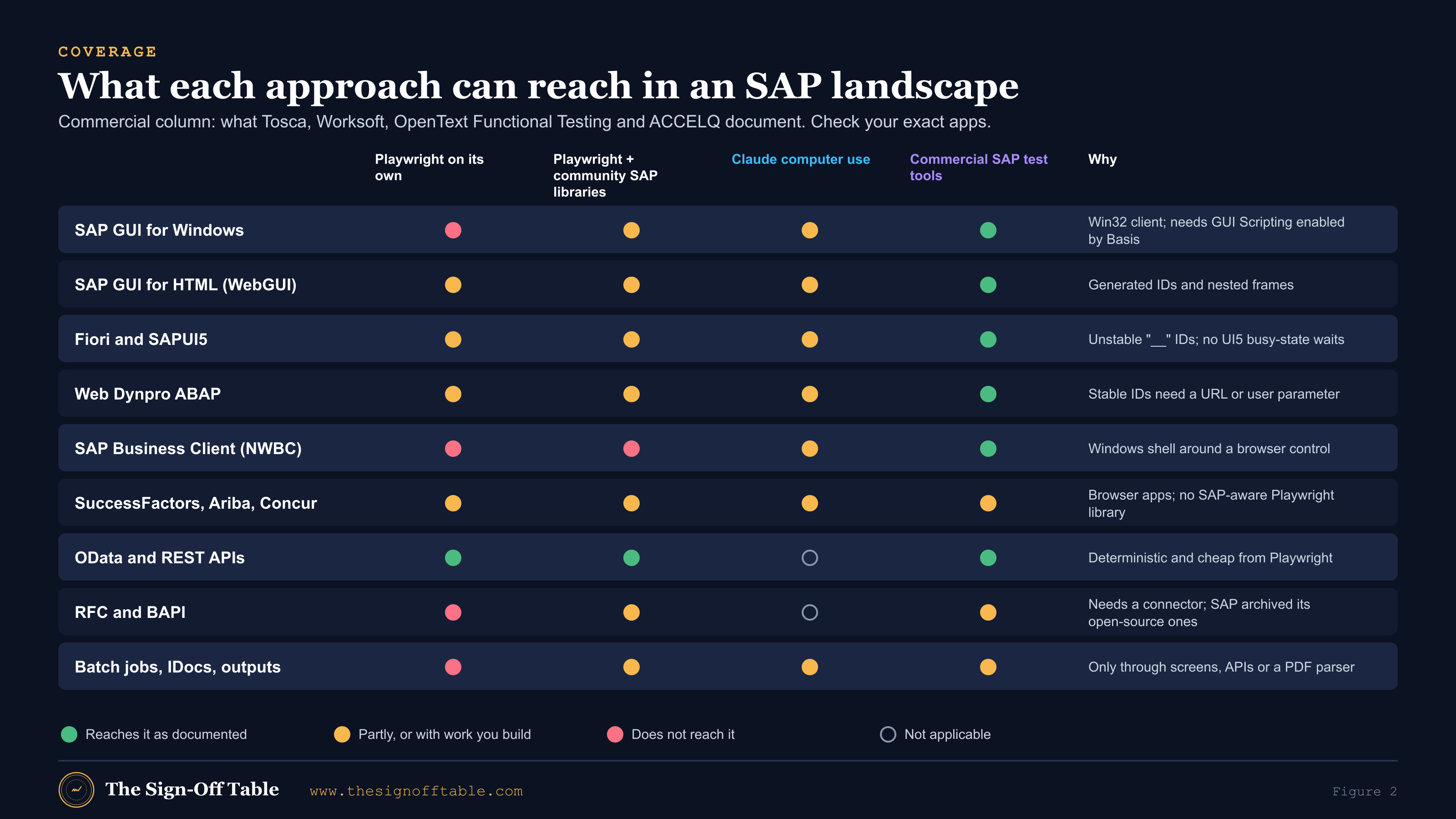
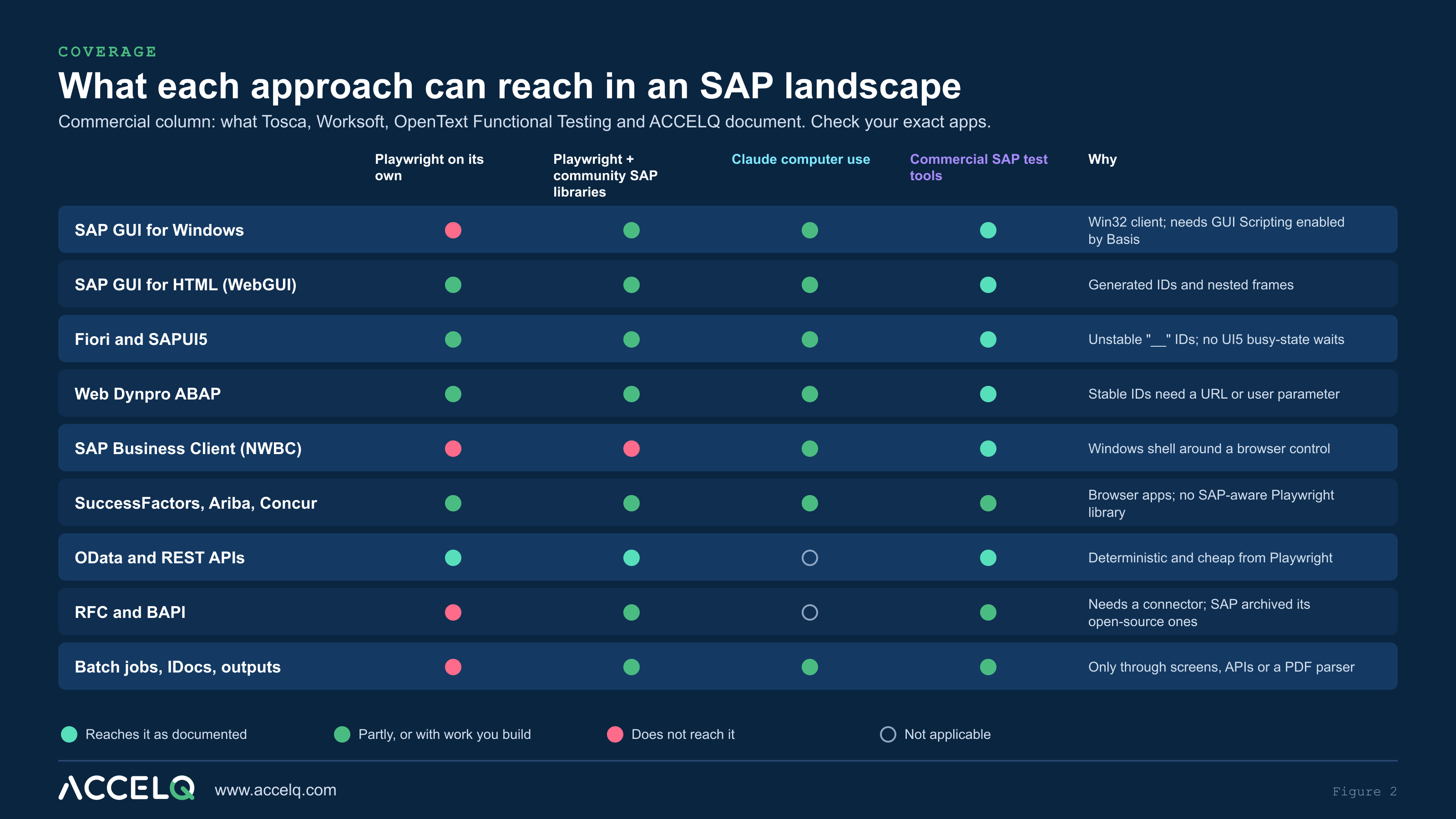
Playwright automates browsers; its only desktop target is Electron, and that support is still described as experimental[7]. SAP GUI for Windows is a Win32 client, and SAP Business Client wraps a browser control in a Windows shell. Playwright drives neither. For many S/4HANA programs, especially private edition and on-premise ones, SAP GUI is still where finance, logistics and Basis work happens.
The workarounds, and what they cost
- SAP GUI Scripting through an MCP server. Several community MCP servers wrap SAP’s GUI Scripting COM API so Claude can call it. All need a Windows host and scripting enabled on the server through profile parameter sapgui/user_scripting, which is off by default and which SAP’s security guide treats as a decision to make deliberately[9],[10]. They are unendorsed community projects.
- Computer use on the GUI. Claude can see SAP GUI on a screen. Anthropic’s own documentation lists the limits: clicks that land near but miss the target, dropdowns and scrollbars that are “tricky,” and a tendency to act as if an action succeeded without checking. It recommends roughly 1280×720 to 1366×768 resolution, low for a dense SAP screen[22]. Benchmarks have improved fast, with Anthropic reporting 81.8% on OSWorld 2.1 for Opus 5.5 against a human baseline of about 72% on the original OSWorld[24],[23], but those benchmarks run on everyday desktop apps, and there is no published result for SAP GUI transactions.
Fairness matters here: the commercial tools lean on GUI Scripting too. OpenText Functional Testing’s SAP add-in, for example, requires scripting enabled on both client and server[114]. The difference is that their SAP GUI support is a maintained, documented product feature rather than a community wrapper, and that their tests run deterministically rather than through a model deciding each click.
Pitfall 3: Fiori and UI5 locators and waits
Fiori is a browser app, so Playwright reaches it. Reaching it reliably is another matter.
- Generated IDs. UI5 generates control IDs such as __xmlview0--__page0. The UI5 Test Recorder documentation says plainly that IDs starting with a double underscore are unstable[12]. Stable IDs are the app developer’s job, and items in bound aggregations, which means the table rows tests care most about, can’t have them[11]. For SAP-delivered apps you don’t control that at all.
- Waiting for UI5, not just the DOM. Playwright auto-waits for elements to be actionable. It knows nothing about UI5’s busy state or pending OData requests. SAP-oriented tools hook UI5’s own autowaiter; wdi5, which replaced the deprecated UIVeri5 as the recommended end-to-end tool, does exactly that[13],[14].
- Virtualized tables and shadow DOM. UI5 tables render only visible rows, so the DOM row count is not the data row count. Playwright pierces open shadow roots, but not closed ones, and XPath does not pierce them at all[5].
- Web Dynpro. Stable IDs need a URL parameter or user parameter, and the user parameter is ignored in clients marked as production[17].
Community libraries close part of the gap. playwright-ui5 adds selector engines that match UI5 control types and properties, but it has a single visible maintainer and limited selector syntax[15]. playwright-sap locates WebGUI and UI5 elements by SAP’s own identifiers, describes itself as relatively new, says it is not affiliated with SAP, and does not support SAP GUI for Windows, Ariba, Concur or SuccessFactors[16]. If you build on them, budget for owning them.
Pitfall 4: end-to-end chains and the backend
SAP regression is rarely one screen. Order to cash runs from a sales order through credit, delivery, picking in EWM, goods issue, billing, an output to the customer and a posting in finance, often with background jobs in between. Several links in that chain aren’t browser screens at all.
- RFC and BAPI. Playwright doesn’t speak RFC. You need a connector, and SAP’s own open-source ones are now archived (PyRFC) or no longer maintained (node-rfc)[18],[19].
- Background jobs, IDocs and outputs. Delivery creation and billing often run as scheduled jobs. A UI agent doesn’t see the outcome until the job runs and someone looks at SM37, WE02 or the output. Headless Chromium downloads PDFs rather than rendering them, so checking an invoice’s content needs a separate parser[8].
- Long flows strain agents. An agent re-reading the page at every step accumulates context, and Playwright MCP’s page snapshots are large; its own README calls the CLI more token-efficient and reserves MCP for agentic loops[2]. Practitioners building Claude skills to avoid MCP cite exactly that token load[42].
A practical consequence: even teams that succeed with Claude and Playwright end up writing a mixed suite of UI steps, OData calls, database checks and job polling, with hand-offs between them. That is a framework, and someone has to design it.
Pitfall 5: tests that pass when they shouldn’t
The most dangerous failure in test automation is not a red test. It is a green one that checked nothing. AI makes this easier to produce at scale.
- Weak assertions. In the largest independent study I found, 216,300 LLM-generated unit tests, many failed to compile and hallucination-driven failures persisted[34]. Another study found LLM-written suites reaching 100% code coverage with a 4% mutation score, meaning they would miss almost any injected bug[35]. Even the SAP Codex write-up’s sample includes an assertion that a response length is at least zero, which can never fail[40].
- Agents grading themselves. When the agent decides pass or fail, you have an oracle problem. The best autonomous web agent in one study gave correct verdicts on about six in ten manual test cases[36], and even the best LLM judges in another reached only about 70% precision deciding whether a web-agent run had succeeded[37]. Anthropic notes Claude can act as if an action succeeded without checking[22]. SAP’s own Architecture Center saw an agent’s self-test pass an app that rendered a blank page[21].
- Healing that hides regressions. Playwright’s healer ends with a passing test, or a skipped test if it believes the functionality is broken[1]. In a suite of thousands, a skipped test is easy to miss, and a heal can rebind a step to the wrong element. Treat every heal as a review item, not as green. The evidence is covered in depth under maintainability and self-healing.
- Nondeterminism. Even at temperature zero, LLM code generation is not fully deterministic[38]. On Anthropic’s API version 2026-10-21, requests that set temperature, top_p or top_k are rejected with an error, even at default values[25], so you cannot ask current Claude models for low-temperature sampling at all. Thinking can’t be switched off on the current 5.5 models either[28]. Patterns 2 and 3 can take a different path through the same test on different runs.
Pitfall 6: audit evidence, SOX and GxP
For many SAP systems, a regression run is not only a quality check. It is evidence for a SOX IT general control on change management, or for computerized system validation in a GxP environment.
- What auditors look for. I found no PCAOB guidance specific to AI-generated or AI-executed test evidence. The usual expectation is a complete population of changes, each with a request, an independent approval, a test record and a deployment record. A test that may take a different path each run, judged by the same agent that ran it, is harder to defend as a test record.
- GxP. The FDA’s final Computer Software Assurance guidance was announced on September 24, 2025[97]. It encourages risk-based, less script-heavy assurance, but 21 CFR Part 11 still requires secure, time-stamped audit trails and validation for consistent intended performance[98]. In the EU, the draft GMP Annex 22 on AI covers static, deterministic models and excludes generative AI from critical GMP applications[99]. ISPE’s GAMP guide on AI sets out a lifecycle for validating AI systems themselves[100], which an AI test agent would now be.
- Your validated state belongs to someone else. Anthropic retires models with at least 60 days’ notice[26]. A validated agent pipeline can be forced into revalidation on the vendor’s schedule, not yours.
- Traceability. SAP Cloud ALM links test cases to scope, processes and requirements, and defects raised from a run are linked automatically[89]. A Playwright suite has none of that unless you build an integration into Cloud ALM and maintain it.
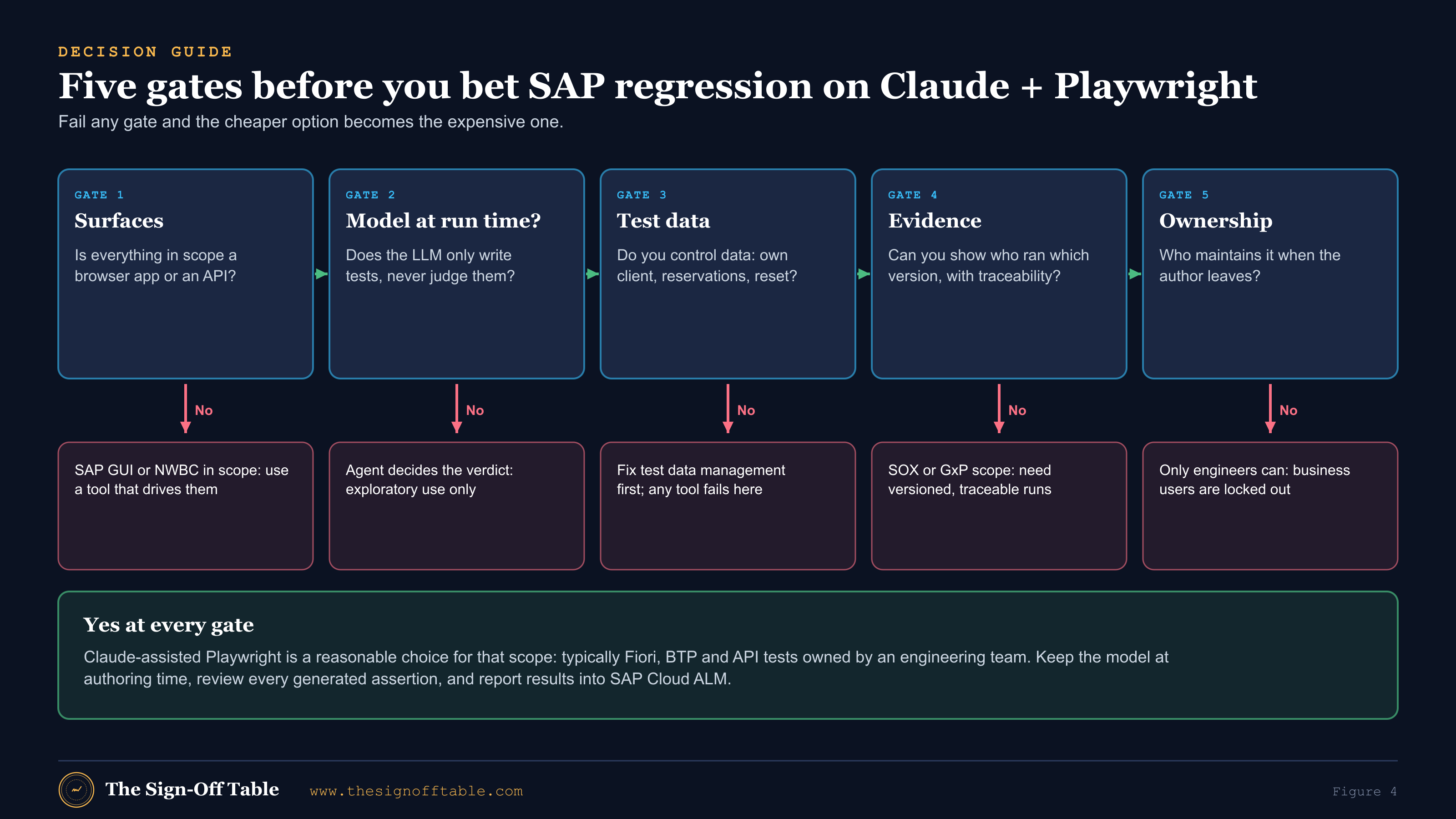
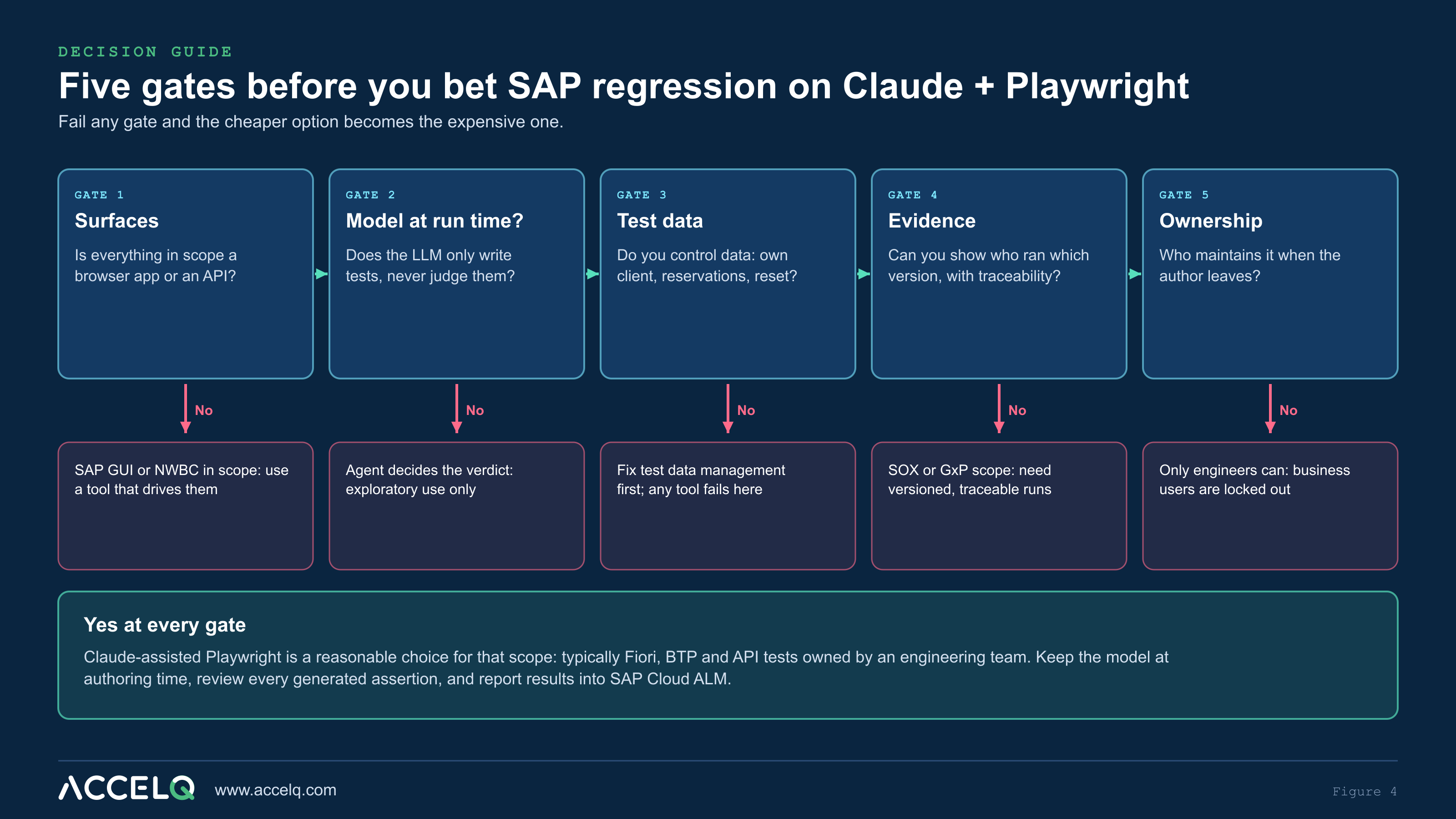
The defensible pattern is the one Gate 4 in the decision guide describes: whatever generates the test, the thing that runs in the regulated pipeline is a versioned, reviewed, deterministic artifact, and its results land in your test management system of record.
Pitfall 7: security, credentials and data leaving
- Prompt injection from SAP data. Anthropic’s computer use documentation warns that Claude may follow instructions it finds in content, even when they conflict with yours[22]. In SAP, free text is everywhere: purchase order notes, vendor names, workflow comments, attachments. Anthropic’s browser-use defenses cut attack success to about 1.4% for Opus 4.5, and Anthropic itself says a rate around 1% still represents meaningful risk[32]. Its Claude in Chrome guidance advises against using it on sensitive work accounts[33]. An ERP is the definition of a sensitive work account.
- Credentials. Anthropic recommends running computer use in a dedicated, minimally privileged VM and avoiding giving the agent login credentials[22]. Playwright MCP says it is not a security boundary, and its secrets option is not a security feature[2]. Claude Code’s own security guidance is to use VMs, avoid piping in untrusted content, and trust MCP servers only as far as you trust their provider[30]. A test user with broad SAP authorizations, in an agent that reads untrusted content, is a real exposure.
- Data leaving the network. Covered under Pitfall 1: every screen the agent reads goes to the model provider, and local transcripts keep it on disk[29],[31].
Pitfall 8: SAP’s 2026 API policy and licensing
This is the newest risk and the least understood. In late April 2026 SAP published version 4/2026 of its API policy. As reported by Hunton Andrews Kurth and Techzine, it restricts the use of SAP APIs by autonomous or generative AI systems that plan, select or execute sequences of API calls, and restricts large-scale extraction, except through SAP-endorsed routes such as Joule, the Integration Suite MCP gateway, A2A and Business Data Cloud. SAP may throttle, suspend or end access[92],[93].
According to ERP Today and an SAP Community analysis, SAP has said deterministic, rule-based automation that follows predefined call sequences does not fall under the agentic AI restriction, and customer or third-party MCP servers are allowed but unsupported[94],[95]. My reading, which is not legal advice: a Playwright or OData script that Claude generated and a person froze looks like deterministic automation. An agent that decides at run time which SAP APIs to call sits much closer to the restricted category. No source I found addresses browser automation of Fiori under the policy. Ask your SAP account team, and your lawyers, before pattern 2 or 3 touches an SAP system through its APIs.
Licensing is the other question. SAP’s Digital Access model counts documents created by bots and RPA whether they come through the UI or an API[96]. Advisers generally say non-production documents are excluded, but check your contract, and check what named-user licence your agent’s test IDs need.
Pitfall 9: the real cost at regression scale
“Playwright is free” is true. A regression program built on it is not.
Token costs, if the model runs at test time
Anthropic’s list prices on November 3, 2026 are $2 per million input tokens and $10 per million output tokens for Sonnet 5.5, and $4 and $20 for Opus 5.5, with a 50% batch discount and cheap cache reads[27]. Each screenshot in computer use costs about 1,000 to 1,800 input tokens[22]. One benchmark of a single admin task found a vision agent took 53 steps and about 551,000 input tokens, against 8 API calls and about 12,000 tokens through structured APIs[43].
| Illustration (my arithmetic, not measured) | Tokens per test run | Cost per test run | 500-test regression pass |
|---|---|---|---|
| Pattern 1: Claude-written Playwright, replayed | None at run time | $0 in tokens | $0 in tokens (authoring and maintenance cost instead) |
| Pattern 2: agent via Playwright MCP, Sonnet 5.5 | About 115,000 in, 5,000 out | About $0.28 | About $140 |
| Pattern 3: computer use, Sonnet 5.5, a long SAP flow | About 550,000 in, 10,000 out | About $1.20 | About $600 |
These are illustrations built from list prices and published benchmarks, not measurements on SAP; dense Fiori pages and long SAP flows probably make them low. Multiply by retries, by every transport import and by every release, and token cost becomes a real line item. More importantly, it becomes a variable one.
People costs, either way
The larger cost is engineering time. The US median wage for software QA analysts and testers was $102,610 in May 2024[45]. A Claude-plus-Playwright regression program needs engineers who know TypeScript, Playwright, UI5, SAP test data and your business processes, plus the framework they build: data reservation, chaining, job polling, Cloud ALM reporting, evidence storage and locator libraries. Claude Code itself averages about $13 per developer per active day for interactive use[28], which is small next to salaries but not zero.
The honest comparison is not “free versus a licence.” It is “a licence plus a smaller team” versus “tokens plus a framework team,” measured over three years and at least six SAP releases.
Pitfall 10: who maintains it, and who is locked out
- Functional consultants and key users are locked out. SAP testing has always depended on the people who know the process. Even the most enthusiastic SAP agent write-up concedes that a functional expert must define what correct behavior is[40]. A TypeScript repository is a wall between them and the tests.
- Key-person risk. In Microsoft’s conversion work, output quality depended heavily on how prompts were written[41]. The prompts, agent rules, skills and harness become critical assets that one or two people understand. They need version control, review and documentation like any code.
- Churn you don’t control. Models retire on about 60 days’ notice[26], sampling parameters changed with an API version[25], and Playwright’s agent definitions must be regenerated when Playwright updates[1]. Add SAP’s own cadence: S/4HANA Cloud Public Edition upgrades twice a year, with the test system first, and regression after go-live is the customer’s job[91].
Maintainability and self-healing: what the evidence says
Every test automation program is decided in year two, not week two. Creating tests is the cheap part; keeping them trustworthy through releases is where the money goes. That is true of Playwright, Tosca, Worksoft, OpenText and ACCELQ alike, and it is the part of the Claude story that demos skip, because a demo never has a second release. This section pulls together the peer-reviewed research on why automated UI tests break, why they flake, how well self-healing fixes it, and where healing creates a new problem.
Two kinds of false result, and why the difference matters
A false positive in test automation is a failure when the application is fine: the locator broke, the page was slow, the data was consumed. A false negative is a pass when the application is broken. False positives cost time and trust; false negatives cost defects in production. Self-healing exists to cut false positives, and the risk it carries is that it creates false negatives. Any honest evaluation of a tool, or of Claude and Playwright, has to measure both.
Why UI tests break: mostly locators
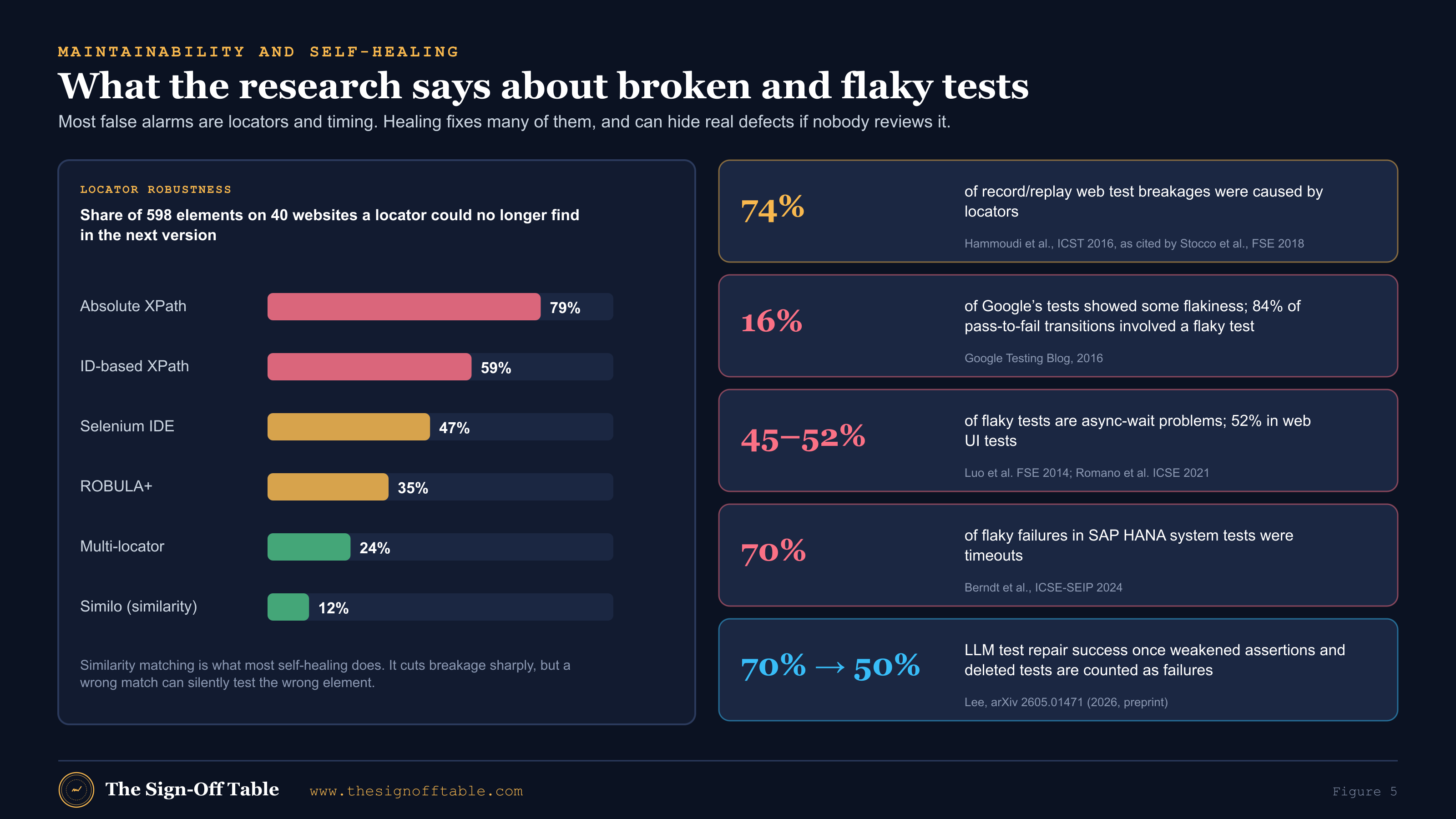
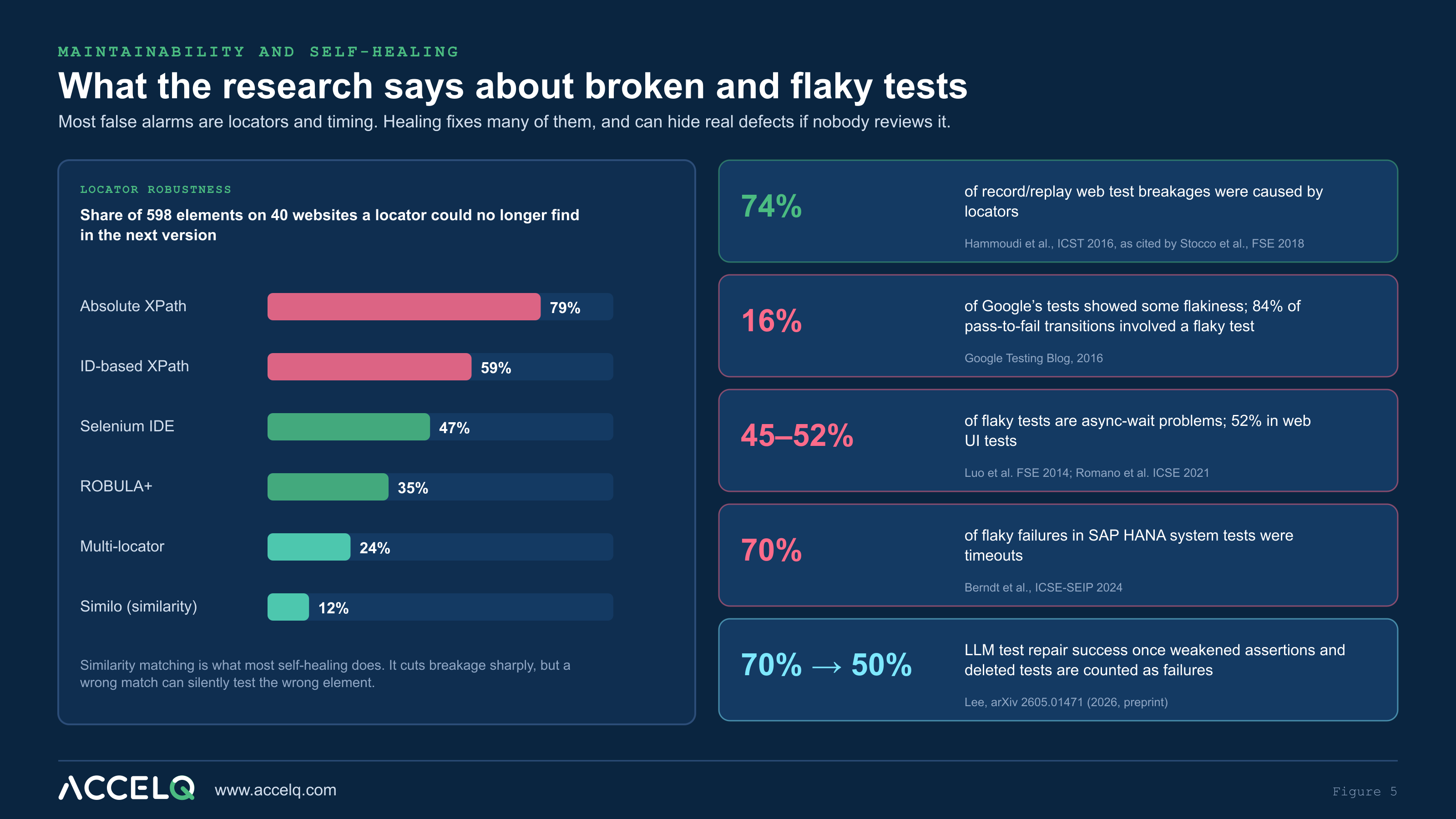
- In 1,065 breakages across 453 versions of web applications, Hammoudi, Rothermel and Tonella found locators caused over 73% of record/replay test breakages, and attribute-based locators alone over half[46]; Stocco and colleagues cite the same study at 74%[47]. Both figures come from summaries of the paper, so treat the exact percentage as approximate.
- In Stocco’s own study of 86 releases of four applications, 12% of 2,672 tests broke at least once, and 80% of the broken tests broke more than once[47].
- Across 287 Java web applications using Selenium, 75% of test files saw at most three modifications before being deleted or rewritten beyond recognition, and the most frequently changed lines were constants and assertions, mostly locator strings and expected values[48].
- In SAP terms: UI5’s own testing documentation says generated IDs will change when the application changes, and that the Fiori Elements template can change with a UI5 minor version upgrade[70]. Controls in bound aggregations, the table rows tests care about most, can’t have stable IDs at all[11]. Every SAP release, Feature Pack and UI5 upgrade is a locator event. I found no study that measures UI5 ID churn across releases, which is itself worth knowing.
Why UI tests flake: mostly timing
- Google reported that about 1.5% of its test runs were flaky, almost 16% of its tests showed some flakiness, and about 84% of transitions from pass to fail involved a flaky test[54]. A later Google study found 41% of test targets that had both passed and failed were flaky[55].
- The classic root-cause study, 201 fixes in 51 Apache projects, put async waits behind 45% of classified flaky tests and concurrency behind 20%[53]. For UI tests, Romano and colleagues found async waits behind 45% of 235 flaky UI tests overall and 52% in web projects[57].
- SAP has studied this on its own software. Re-running SAP HANA system tests on the same revision for six months found flakiness rates of 49 to 70% depending on the number of repetitions, with timeouts causing 70% of flaky failures; tuning cut timeout-related flaky failures by 80%[59]. Those are database system tests, not UI tests, but they show how much SAP-scale test noise is timing.
- For modern end-to-end frameworks, a 2026 preprint on 86 flaky Cypress and Playwright tests found the test code and CI log explained only 42% of them; the rest needed more execution evidence[60].
The trust cost is the real cost. Google noted it became common for engineers to ignore legitimate failures in flaky tests[54]. In Parry and colleagues’ survey of the literature, 59% of developers dealt with flaky tests monthly or more, and 47% of failed builds that were manually restarted then passed[56]. Developers surveyed by Gruber and Fraser said their biggest worry was losing trust in test outcomes, more than compute cost[58]. A regression suite people have learned to rerun until green has stopped being a control.
This matters for Claude at run time (patterns 2 and 3). UI5 already makes async waiting hard, because Playwright doesn’t know about UI5’s busy state. A model that may take a different path each run adds a second source of noise on top of the one that already causes about half of flaky UI tests.
Design reduces maintenance more than tooling does
- An industrial case study found page objects cut maintenance time roughly threefold[50], and a comparison of capture-replay with programmable tests found the programmable approach became cheaper after one to three releases[49].
- At Siemens and Saab, frequent maintenance of visual GUI tests was cheaper than letting breakages pile up for a “big-bang” fix[51].
- In an eight-month study of keyword-driven tests at a bank, over 30% of keywords were duplicated even in a modular suite, and better design could have cut test-code changes by about 70%[52]. Modular, model-based tools help only if someone keeps the model clean.
This is a point in favor of the reusable-module designs that Tosca, Worksoft and ACCELQ are built around, and a warning for all of them: reuse has to be governed. It is also a direct warning for AI-generated code. The 216,300-test study found the Magic Number Test smell, hard-coded values with no explanation, in 85.64 to 100% of LLM-generated tests across prompting strategies[34]: the opposite of the shared, parameterized design the research rewards. Even Meta’s production pipeline, which filters LLM output heavily, reported that 75% of generated tests built and 57% passed reliably[69].
Does self-healing work? Yes, measurably
Most self-healing is a form of similarity matching: when the stored locator fails, find the element that best matches the recorded attributes. The research says this works.
- Across 598 elements on 40 websites, the share a locator could no longer find in the next version was 79% for absolute XPath, 47% for Selenium IDE locators, 35% for ROBULA+, 24% for a multi-locator approach and 12% for Similo’s similarity matching[62]. ROBULA+ alone cut fragility by about 90% against absolute XPath[61].
- Visual repair (VISTA) fixed 81% of 733 breakages, against 57% for the earlier DOM-based WATER approach[47].
- LLMs help further. Combining matching tools with an LLM raised correct repairs, with the best setup fixing 88% of 139 broken statements, but only as the best of four runs; on average it succeeded in under three of four[65]. On Android, LLM repair made 74% of broken tests executable after one attempt and 92% after several, against 23% for the open-source Healenium tool, at two to three times the time per repair[67].
Where self-healing goes wrong: the false negatives
- A wrong match is worse than a failure. An independent replication of Similo found its LLM-assisted variant produced more wrong-element matches than the original, and explained why that is dangerous: the test carries on down the wrong path and fails later, or not at all[64].
- Thresholds trade safety for coverage. In the VON Similo study, a threshold that made matches 100% precise found only 47.5% of the elements[63]. A healer tuned to heal everything will heal things it shouldn’t.
- Repair can change what a test checks. In the LLM repair study, one “fix” found the right element but no longer did what the original statement intended[65]. In a 2026 preprint on an LLM multi-agent repair system for Playwright, 70% of runs converged on a naive measure but only 50% on a strict one, because the agent had weakened assertions, for example from an exact match to “is truthy,” or deleted tests; 12% of its reports contained hallucinated APIs or selectors[66]. That single-author paper is not yet peer reviewed, but it is the most direct evidence I found that autonomous repair manufactures false negatives.
- Quarantine has the same failure mode. Google warned that quarantining flaky tests could mask a real race condition[54].
- Playwright’s healer. It reruns a failing test until it passes or its guardrails stop it, and its output is a passing test, or a skipped test if it believes the functionality is broken[1]. The guardrails aren’t described, the page says nothing about human review, and in most CI setups a skip doesn’t block a release. I found no independent evaluation of it.
Self-healing as the tools document it
No vendor publishes independently verified heal-success or wrong-heal rates, so the comparison has to be on mechanism and governance.
| Tool | Mechanism (as documented) | Human in the loop | Worth knowing |
|---|---|---|---|
| Playwright healer | An LLM agent finds “equivalent elements or flows” and reruns until pass or skip[1] | Not described | A skip can hide a real defect; no published guardrails |
| Tricentis Tosca | Weighted (default threshold 0.75) or combination matching of stored properties[71] | Healed runs are flagged; the module changes only when a user applies the healed properties | SAP GUI is not among the engines the self-healing page lists; check before relying on it |
| ACCELQ | Self-healing on by default; reports show healing activity[129] | Heals are reported for review | Deliberately not applied to checks that an element has disappeared, so a negative check can’t be healed into a pass |
| OpenText Functional Testing | AI object detection, including SAP GUI[72] | Warnings in the run report | If verification can’t find the object, the action runs at the originally identified location, with only a warning |
| Worksoft | Enhanced self-healing in the 2026 platform (vendor material)[112] | Not publicly documented | I found no primary documentation of the mechanism |
| Healenium (open source) | Heals above a configurable score cap; can be disabled per method[68] | Code changes need a separate plugin | Healed 23% of broken Android tests in one comparison[67] |
How to govern healing, whichever tool you use
Self-healing governance checklist
- Every heal is logged with the old locator, the new match and its confidence, and lands in a review queue
- Heals are never written back to the test asset automatically; a person approves the change
- A confidence threshold is set deliberately and recorded, with the precision trade-off understood
- Assertion changes, scope changes and deleted or skipped tests are never auto-approved
- Negative checks (an element must not exist, a value must not change) are excluded from healing
- Healed and skipped counts are reported per run alongside pass and fail, and trended over time
- A sample of healed passes is re-verified by hand each release to measure the wrong-heal rate
- Flaky tests are fixed or removed on a deadline, not quarantined indefinitely
- Waits use the application’s own readiness signal (UI5’s autowaiter, OData completion), not fixed sleeps
- Locators prefer stable IDs and control-level attributes over generated IDs and absolute paths
The practical conclusion is not “self-healing good” or “self-healing bad.” Healing reduces false positives and carries a false-negative risk, and that risk is managed with review, thresholds and reporting. A platform that surfaces heals for approval and refuses to heal negative checks is safer than an agent that decides on its own whether a failure is a defect. Ask every vendor, and ask the owner of any Claude-built framework: show me last release’s heals, who approved them, and how many were wrong.
Side by side: Claude, Tosca, Worksoft, UFT One, ACCELQ and SAP
The table below compares what each option documents, not what it claims in a sales deck. Where a capability rests on a vendor claim I couldn’t verify, it says so. Ratings would hide too much, so each cell describes the approach.
| SAP GUI for Windows | Test design | Test data | Change impact | SAP Cloud ALM | Main watch-outs | |
|---|---|---|---|---|---|---|
| Claude alone (computer use or MCP) | Sees it through screenshots or community GUI Scripting servers | Natural-language goals; the model decides each step at run time | None; the agent reads whatever is on screen | None | None; build it | Nondeterminism, self-judged verdicts, cost per run, prompt injection, SAP API policy |
| Claude + Playwright (Claude writes code) | Not supported by Playwright[7] | TypeScript tests, generated and reviewed | Do-it-yourself; Playwright says control your data[4] | None | Possible through APIs; you build and own it | Framework ownership, UI5 locator fragility, weak assertions, engineers only |
| Tricentis Tosca | Supported, including NWBC[108] | Model-based, codeless modules; agentic generation on top | Test Data Service locking; Tosca Cloud test data[105],[106] | SAP Change Impact Analysis (LiveCompare)[104] | Integrated; Tosca engine behind SAP’s bundled test automation[107],[87] | Cost and per-module licensing; agentic features need cloud or hybrid Tosca and carry prompt limits |
| Worksoft | Supported (vendor claim)[111] | Codeless, built from process capture of real user sessions | Recordsets with write-back; Data Connect with a TDM partner[113],[112] | Worksoft Impact (vendor claim)[112] | Integration claimed[111]; long SolMan certification history[110] | Cost; less public documentation; no MCP server found |
| OpenText Functional Testing (UFT One) | SAP add-in; needs GUI Scripting on client and server[114] | Scripted (VBScript, now Python) with keyword view and AI object recognition | Data tables; SAP table parameterization[117] | Not found in the testing product | SolMan Test Suite integration[118]; no Cloud ALM integration found | Windows-only, heavy on VMs, scripting skills, SolMan-era integration |
| ACCELQ | Supported on ECC 6.0 and later[120] | Codeless, business-process modeled; AI agents assist | Data-driven scenarios with data types and lists[124] | Claimed for S/4HANA releases, without public evidence[134] | Native integration in development, not GA | Cloud platform with a local agent; pricing by quote; AI benchmarks vendor-reported |
| SAP’s own (Cloud ALM, test automation tool) | Bundled tier documented for browser apps; check current scope | Recorded and configured tests; Tricentis engine in Cloud ALM | Test data containers in the Public Edition tool[82] | Through the Tricentis-based SAP solution extensions | Native[87] | Test automation tool is Public Edition only[90]; no home-grown engine in Cloud ALM |
The commercial tools, objectively
Tricentis Tosca
Tricentis has been an SAP solution extension partner since 2020, so SAP’s own sales force resells its tools under SAP names, including SAP Enterprise Continuous Testing by Tricentis and SAP Change Impact Analysis[101]. SAP Cloud ALM has no home-grown automation engine, and customers on SAP Enterprise Support are entitled to a Tricentis-based test automation tier provisioned from Cloud ALM[87]. Tosca is model-based and codeless. On AI, Tricentis released remote MCP servers for Tosca and its other products in June 2025, naming Anthropic among its AI partners[102], agentic test automation for Tosca that requires cloud or hybrid deployment and comes with a limited number of prompts[103], and in May 2026 agentic test generation inside SAP Enterprise Continuous Testing, consumed through SAP AI Units, plus code-level impact analysis for ABAP[104]. Tricentis reports being named a Leader in Gartner’s 2026 Magic Quadrant for Agentic Software Quality Assurance Platforms[109]. The watch-outs are cost, granular module licensing and a proprietary test format.
Worksoft
Worksoft has a long SAP history: its Certify product was the first certified for Solution Manager’s test automation framework, and it was later certified for the SolMan 7.2 test suite[110]. It builds codeless automation from process capture, recording real user sessions. Its 2025 release claimed coverage of S/4HANA, SAP GUI, Fiori, Ariba, SuccessFactors and Concur and an SAP Cloud ALM integration[111], and its 2026 platform adds AI failure diagnosis, self-healing and impact-driven prioritization, with test data through a partner[112]. Much of this rests on Worksoft’s own material; I found little independent documentation and no MCP server or natural-language test generation.
OpenText Functional Testing (formerly UFT One)
OpenText now markets UFT One as OpenText Functional Testing[115]. Its SAP add-in covers SAP GUI for Windows, Fiori and UI5, NWBC and SuccessFactors, and needs SAP GUI Scripting enabled on both client and server[114]. Tests are scripted, now in Python as well as VBScript. Its 2026 AI features include Smart Verify, plain-language AI checkpoints that return true or false[116], and an Aviator assistant that runs on the customer’s own LLM. Its certified SAP integration is with the Solution Manager test suite[118]; I found no Cloud ALM integration, which matters as SolMan mainstream maintenance ends on December 31, 2027[88]. Reviewers commonly cite resource use and scripting skills as drawbacks.
ACCELQ
ACCELQ is a cloud-based, codeless test automation platform for functional and API testing with test management alongside[119]. It automates SAP GUI transactions on ECC 6.0 and later without scripting[120], mixes UI, API and database steps in one scenario[121], and offers an MCP server for AI assistants[131]. ACCELQ reports being named a Leader in The Forrester Wave: Autonomous Testing Platforms, Q4 2025[133]. SAPinsider’s review notes its self-healing still “needs performance evidence”[134]. Its native SAP Cloud ALM integration is in development, not generally available; pricing is by quote; and its AI benchmarks are vendor-reported. How it addresses this guide’s pitfalls is covered in the disclosed section below.
SAP’s own tooling
SAP Cloud ALM is the test management hub for SAP programs, with traceability from scope to defect[89]. It has no home-grown automation engine and stays open to third-party tools, and SAP says its older component-based test automation (CBTA) will be supported as long as Solution Manager is, but won’t be extended to SAP’s cloud products[87]. The test automation tool for S/4HANA Cloud is embedded in, and limited to, Public Edition[90]. Private edition and on-premise programs therefore need another engine, whichever one they choose.
A decision guide
Most SAP landscapes are not one scope, so make this decision per scope: Fiori apps, SAP GUI processes, integrations, SaaS apps. Pass a scope through five gates.
| Scope | A reasonable default | Why |
|---|---|---|
| Custom Fiori or BTP apps your team builds | Claude-assisted Playwright or wdi5, model at authoring time | You control IDs, data and code; engineers own both |
| OData and integration APIs | Playwright API tests or any tool with API steps | Deterministic, fast and cheap with any of them |
| SAP GUI processes in finance and logistics | A commercial tool that documents SAP GUI | Playwright can’t reach it; computer use isn’t evidence |
| End-to-end chains across SAP GUI, Fiori, EWM and SaaS | A commercial tool with data reservation and chaining | Test data and hand-offs dominate the effort |
| SOX or GxP regression | Deterministic, versioned tests reporting into Cloud ALM | Evidence and traceability, whatever generates the tests |
| Exploratory checks and triage | Claude with Playwright MCP, in a masked client | Fast and useful, with a person judging the findings |
If you go ahead: minimum controls
If you decide Claude and Playwright are right for part of your landscape, these controls are the difference between a cheap tool and a cheap-looking one.
Minimum controls for Claude-assisted SAP testing
- The scope is written down: which apps, which surfaces, and which SAP GUI processes are explicitly out
- The model writes tests; it does not run regression or decide verdicts. Committed tests run without model calls
- Every generated assertion is reviewed against the requirement, and a sample is mutation-tested
- Every heal or skip from the healer is a review item, never an automatic green
- Locators use UI5-aware engines or stable IDs; generated “__” IDs fail code review
- A dedicated, masked test client or tenant; no production copy is read by a hosted model without a legal basis
- Test data is reserved per run, document numbers are chained explicitly, and consumed records are logged
- Periods, stock, credit and number ranges are checked as preconditions before the suite starts
- The agent’s SAP user has the least authorizations needed and its credentials live in a secrets manager
- Claude Code transcripts and MCP servers are covered by the security review; zero data retention is confirmed where needed
- SAP’s API policy has been reviewed with your SAP account team for any agent that calls SAP APIs
- Results, versions and evidence are reported into SAP Cloud ALM or your test management system of record
- Prompts, agent rules and the framework are version-controlled, reviewed and owned by more than one person
- Model and Playwright upgrades go through change control, with a regression of the suite itself
- Token spend per run is measured and has a budget owner
How ACCELQ approaches these gaps
This section names ACCELQ. Matt Angerer, who runs The Sign-Off Table, works at ACCELQ (disclosure). Everything above is tool-neutral, and the same questions apply to any tool you evaluate.
ACCELQ’s position is pattern 4: keep AI in authoring, under human approval, and run deterministic tests on a platform built for packaged apps. Mapped against the pitfalls:
| Pitfall | How ACCELQ addresses it today | What to verify in a pilot |
|---|---|---|
| SAP GUI coverage | SAP GUI automation on ECC 6.0 and later without scripting[120] | Your transactions, GUI version and scripting settings |
| End-to-end chains | UI, API and database steps in one scenario[121],[122],[123] | One full order-to-cash chain, including the job and output steps |
| Test data | Data-driven scenarios with data types and data lists[124] | Reservation and chaining across parallel runs in your QA client |
| False passes | Self-healing that reports what changed[129]; tests generated by Autopilot are reviewable[125] | Review every heal; SAPinsider notes self-healing still needs performance evidence |
| Human approval of AI output | The MCP server proposes a plan for approval before creating tests[131]; Converse output is reviewed before execution[132] | That approvals are recorded where auditors can see them |
| Evidence and traceability | Requirement traceability with Jira, Azure DevOps and Rally[130]; suites triggered from CI or a REST call[126],[127] | Cloud ALM: the native integration is in development, not GA |
| Security and on-premise access | A pull-only Local Agent executes behind the firewall[128] | Where data and evidence are stored; your security review |
| Who maintains it | Codeless, business-process modeled scenarios | Whether your functional consultants can actually author and maintain tests |
Feature availability depends on the ACCELQ plan[125]. As with every vendor in this guide, measure AI productivity claims on your own flows, and pilot on your hardest scope, not your easiest.
Templates and related guides
Before you pilot any option, Claude-based or commercial, put these planning documents in place:
- An SAP test data management strategy, and a client strategy saying which client holds which data
- A test environment and data readiness report, checked before every cycle
- A tool evaluation scorecard, and a pilot scorecard for any AI testing tool
- A review checklist and log for AI-generated tests, and an acceptable use policy for AI in testing
- An automation ROI model over three years and at least six SAP releases
- Framework standards, and a requirements traceability matrix
Templates. Free to download from the template library:
| Need | Template |
|---|---|
| Plan SAP test data | SAP test data management strategy |
| Decide which client holds which data | Test data and client strategy |
| Check readiness before a cycle | Test environment and data readiness report |
| Compare tools objectively | Test tool vendor evaluation scorecard |
| Pilot an AI testing tool | AI testing tool pilot and evaluation scorecard |
| Review AI-written tests | AI-generated test review checklist and log |
| Set the rules for AI in testing | AI in delivery and testing: acceptable use policy |
| Build the business case | SAP test automation ROI calculator |
| Set framework standards | SAP test automation framework standards |
| Trace tests to requirements | Requirements traceability matrix |
Related guides. S/4HANA test data management, SAP AI for practitioners, S/4HANA regression automation, SAP Cloud ALM test automation integration and getting started with SAP Cloud ALM.
Frequently asked questions
Can Claude test SAP?
Yes, in a limited sense. Claude can write Playwright tests for Fiori and APIs, drive a browser through Playwright MCP, or operate SAP GUI on a screen through computer use. Only the first produces repeatable regression tests, and it covers browser surfaces only. See the four patterns.
Can Playwright automate SAP GUI?
No. Playwright automates browsers; SAP GUI for Windows is a Win32 client. SAP GUI for HTML (WebGUI) is reachable as a web page, with fragile generated IDs[7],[16].
Can Playwright test Fiori apps?
Yes, with care: UI5’s generated IDs are unstable and Playwright doesn’t wait for UI5’s busy state. Use stable IDs, UI5-aware selector libraries or UI5’s Test Recorder locators, and consider wdi5, which hooks UI5’s own autowaiter[12],[13].
Is Claude + Playwright cheaper than Tosca or Worksoft?
On licences, yes. Over a multi-year program, not necessarily: you trade licence cost for framework engineering, test data plumbing, Cloud ALM integration and, if the model runs at test time, token spend. See the cost section.
Does Claude solve SAP test data management?
No. It can help design data and write setup scripts, but it has no reservation, chaining, reset or lineage, and an agent reading a production copy sends that data to the model provider. See Pitfall 1.
Are AI-run tests acceptable as SOX or GxP evidence?
I found no regulator or PCAOB guidance that addresses them directly. Part 11 still requires audit trails and consistent intended performance[98]. The defensible approach is AI-assisted authoring with deterministic, versioned execution and traceable results.
Does SAP’s 2026 API policy ban AI test agents?
It restricts autonomous or generative AI systems that plan and execute sequences of SAP API calls, outside SAP-endorsed routes, as reported by legal and trade press; SAP has reportedly said deterministic automation isn’t covered by that restriction[92],[94]. Ask your account team before an agent calls SAP APIs.
What about SAP’s own test automation?
SAP Cloud ALM has no home-grown engine and uses Tricentis for its bundled test automation; the test automation tool for S/4HANA Cloud is Public Edition only[87],[90].
How much of automation effort goes to maintenance?
Popular figures attributed to the World Quality Report, such as half of the automation budget, could not be verified against the reports. The peer-reviewed evidence is clearer on causes than on budget share: locators cause about three-quarters of web test breakages, and async waits about half of flaky UI tests[46],[57]. See maintainability and self-healing.
Does self-healing reduce false positives?
Yes, measurably: similarity matching cut the share of elements a locator could no longer find from 79% with absolute XPath to 12% in one study[62]. The risk is the opposite error, a heal that passes a broken test.
Is self-healing safe?
Only with review. A heal can rebind a step to the wrong element, Playwright’s healer may skip a test it thinks is broken[1], and research shows LLM repair loops can weaken assertions or delete tests[66]. That applies to every vendor’s self-healing, not just Playwright’s. Use the governance checklist in the maintainability section.
Summary and next steps
Claude and Playwright are real tools with a real place in SAP testing: Fiori and BTP apps you build, API tests, scaffolding and exploration. They are not a drop-in replacement for an SAP regression platform, mostly for reasons that have nothing to do with AI quality: SAP GUI, test data, evidence, policy and people. Five things to take away:
- Keep the model at authoring time for anything you will call regression.
- Solve test data first. No tool, AI or otherwise, passes a suite against a QA client with closed periods and consumed orders.
- Decide per scope with the five gates, not for the whole landscape at once.
- Treat the commercial tools skeptically too. Pilot them on your hardest flows and measure their AI claims.
- Put evidence in your system of record, SAP Cloud ALM or equivalent, whatever generates the tests.
Subscribe to the newsletter for updates as the tools, SAP’s API policy and the evidence change.
Sources
- [1]Playwright test agents (planner, generator, healer), Playwright documentation, n.d., accessed November 3, 2026
- [2]Playwright MCP server (README), Microsoft on GitHub, n.d., accessed November 3, 2026
- [3]Parallelism, Playwright documentation, n.d., accessed November 3, 2026
- [4]Best practices, Playwright documentation, n.d., accessed November 3, 2026
- [5]Locators, Playwright documentation, n.d., accessed November 3, 2026
- [6]API testing, Playwright documentation, n.d., accessed November 3, 2026
- [7]Desktop application support (issue discussion on Electron and native apps), Microsoft Playwright on GitHub, n.d., accessed November 3, 2026
- [8]PDF handling in headless Chromium (issue 6342), Microsoft Playwright on GitHub, 2021
- [9]SAP GUI Scripting security guide, SAP Help Portal, n.d., accessed November 3, 2026
- [10]SAP GUI Scripting (topic page), SAP Community, n.d., accessed November 3, 2026
- [11]Stable IDs: all you need to know, SAPUI5 documentation, n.d., accessed November 3, 2026
- [12]Test Recorder, SAPUI5 documentation, n.d., accessed November 3, 2026
- [13]wdi5: UI5 end-to-end testing with WebdriverIO (source, waitForUI5 and the UI5 autowaiter), UI5 community on GitHub, n.d., accessed November 3, 2026
- [14]@ui5/uiveri5 (deprecated; points to wdi5), npm, n.d., accessed November 3, 2026
- [15]playwright-ui5: UI5 selector engines for Playwright, GitHub (community project), n.d., accessed November 3, 2026
- [16]playwright-sap: FAQs and SID locators for SAP WebGUI and UI5 (community project, not affiliated with SAP), playwright-sap.dev, n.d., accessed November 3, 2026
- [17]KBA 1933805: stable IDs in Web Dynpro ABAP for test automation, SAP Support, n.d., accessed November 3, 2026
- [18]PyRFC (archived repository), SAP-archive on GitHub, n.d., accessed November 3, 2026
- [19]node-rfc (no longer maintained), SAP on GitHub, n.d., accessed November 3, 2026
- [20]UI5 MCP server, UI5 on GitHub (SAP SE), 2025
- [21]Agentic engineering: building a CAP and Fiori Elements app with Claude Code, MCP servers and Playwright, SAP Architecture Center, April 27, 2026
- [22]Computer use tool, Claude Platform documentation (Anthropic), n.d., accessed November 3, 2026
- [23]OSWorld: benchmarking multimodal agents for open-ended tasks in real computer environments, Xie et al., arXiv 2404.07972, 2024
- [24]Claude Opus 5.5, Anthropic, September 22, 2026
- [25]Migrating to API version 2026-10-21 (sampling parameters), Claude Platform documentation (Anthropic), October 2026
- [26]Model deprecations, Claude Platform documentation (Anthropic), n.d., accessed November 3, 2026
- [27]Pricing, Claude Platform documentation (Anthropic), n.d., accessed November 3, 2026
- [28]Manage costs effectively (Claude Code), Claude Code documentation (Anthropic), n.d., accessed November 3, 2026
- [29]Data usage (Claude Code), Claude Code documentation (Anthropic), n.d., accessed November 3, 2026
- [30]Security (Claude Code), Claude Code documentation (Anthropic), n.d., accessed November 3, 2026
- [31]API and data retention, including zero data retention, Claude Platform documentation (Anthropic), n.d., accessed November 3, 2026
- [32]Mitigating the risk of prompt injections in browser use, Anthropic research, November 24, 2025
- [33]Use Claude in Chrome safely, Claude Help Center (Anthropic), n.d., accessed November 3, 2026
- [34]Large-scale, independent and comprehensive study of the power of LLMs for test case generation (216,300 tests), arXiv 2407.00225, accepted in Empirical Software Engineering, v4 March 4, 2026
- [35]Mutation-guided LLM-based test generation (MutGen), arXiv 2506.02954, 2025–2026
- [36]Are autonomous web agents good testers?, arXiv 2504.01495, April 2, 2025
- [37]AgentRewardBench: evaluating automatic evaluations of web agent trajectories, arXiv 2504.08942, 2025
- [38]LLM is like a box of chocolates: the non-determinism of ChatGPT in code generation, arXiv 2308.02828, 2023
- [39]We have a package for you! A comprehensive analysis of package hallucinations by code generating LLMs, Spracklen et al., USENIX Security 2025, 2025
- [40]Automated SAP testing with Codex CLI, Daniel Vaughan, June 13, 2026
- [41]From manual testing to AI-generated automation: our Azure DevOps MCP + Playwright success story, Microsoft DevOps Blog, July 24, 2025
- [42]Discussion: a Playwright skill for Claude Code instead of Playwright MCP, Hacker News, 2025
- [43]Computer use is 45x more expensive than structured APIs, Reflex, April 27, 2026
- [44]Gartner predicts over 40% of agentic AI projects will be canceled by end of 2027, Gartner newsroom, June 25, 2025
- [45]Software developers, quality assurance analysts, and testers (Occupational Outlook Handbook), US Bureau of Labor Statistics, May 2024 wage data
- [46]Why do record/replay tests of web applications break? (summary of Hammoudi, Rothermel and Tonella, ICST 2016), The Morning Paper (Adrian Colyer), May 30, 2016
- [47]Visual web test repair (VISTA), Stocco, Yandrapally and Mesbah, ESEC/FSE 2018, 2018
- [48]Prevalence and maintenance of automated functional tests for web applications, Christophe, Stevens, De Roover and De Meuter, ICSME 2014, 2014
- [49]Capture-replay vs. programmable web testing: an empirical assessment during test case evolution, Leotta, Clerissi, Ricca and Tonella, WCRE 2013, 2013
- [50]Improving test suites maintainability with the page object pattern: an industrial case study, Leotta, Clerissi, Ricca and Spadaro, ICSTW 2013, 2013
- [51]Maintenance of automated test suites in industry: an empirical study on visual GUI testing, Alégroth, Feldt and Kolström, Information and Software Technology 73, 2016
- [52]On the evolution of keyword-driven test suites (industrial study), Rwemalika et al., ICST 2019, 2019
- [53]An empirical analysis of flaky tests, Luo, Hariri, Eloussi and Marinov, FSE 2014, 2014
- [54]Flaky tests at Google and how we mitigate them, Google Testing Blog (John Micco), May 27, 2016
- [55]Taming Google-scale continuous testing, Memon et al., ICSE-SEIP 2017, 2017
- [56]A survey of flaky tests, Parry, Kapfhammer, Hilton and McMinn, ACM TOSEM 31(1), 2022
- [57]An empirical analysis of UI-based flaky tests, Romano et al., ICSE 2021, 2021
- [58]A survey on how test flakiness affects developers and what support they need to address it, Gruber and Fraser, ICST 2022, 2022
- [59]Taming timeout flakiness: an empirical study of SAP HANA, Berndt, Baltes and Bach, ICSE-SEIP 2024, 2024
- [60]Flaky end-to-end tests in Cypress and Playwright suites (preprint), Gültekin, Berndt, Bell, Bach and Baltes, arXiv 2607.09345, July 2026
- [61]ROBULA+: an algorithm for generating robust XPath locators for web testing, Leotta, Stocco, Ricca and Tonella, Journal of Software: Evolution and Process 28(3), 2016
- [62]Similarity-based web element localization for robust test automation (Similo), Nass, Alégroth and Feldt, ACM TOSEM 32(3), 2023
- [63]Improving web element localization by using a large language model (VON Similo), Nass et al., arXiv 2301.03863, 2023
- [64]Independent replication and extension of similarity-based web element localization (HybridSimilo), Kluge and Stocco, arXiv 2505.16424 v2, December 2025
- [65]Understanding and enhancing attribute prioritization in fixing web UI tests with LLMs, Xu, Li and Tan, ICST 2025 (arXiv 2312.05778), 2025
- [66]Practical limits of autonomous test repair (preprint), Lee, arXiv 2605.01471, May 2026
- [67]LLM-based repair of broken GUI tests on Android, compared with Healenium (VST workshop), Fulcini, Poletti, Arnaudo and Coppola, SANER 2026 companion, 2026
- [68]Healenium web: self-healing for Selenium (score cap and per-method disabling), Healenium on GitHub, n.d., accessed November 3, 2026
- [69]Automated unit test improvement using large language models at Meta (TestGen-LLM), Alshahwan et al., FSE 2024 Industry, 2024
- [70]UIVeri5 locators: why generated UI5 IDs should not be used, SAP UIVeri5 documentation (via jsDelivr), n.d., accessed November 3, 2026
- [71]Self-healing (Tosca 2026.1), Tricentis documentation, n.d., accessed November 3, 2026
- [72]AI-based testing (concepts, including AI object detection), OpenText Functional Testing help, 26.1–26.3, 2026
- [73]SAP S/4HANA Cloud test data refresh: FAQ, SAP Community (topic page), n.d., accessed November 3, 2026
- [74]Client copy, SAP Help Portal (SAP NetWeaver 7.3), n.d., accessed November 3, 2026
- [75]Data Processing Agreement for SAP Cloud Services (v8-2021), section 2.1.3, SAP, 2021
- [76]Executing the main SAP Credit Management operations, SAP Learning, n.d., accessed November 3, 2026
- [77]Availability check (ATP) logic, SAP Help Portal (legacy release), n.d., accessed November 3, 2026
- [78]KBA 1843002: gaps and jumps in number assignment, SAP Support, n.d., accessed November 3, 2026
- [79]MIGO posting period error (M7053) discussion, SAP Community, 2025
- [80]Transferring master data from SAP ERP to SAP EWM, SAP Learning, n.d., accessed November 3, 2026
- [81]Creating SAP test systems: an alternative to SAP TDMS (quotes SAP Note 2908617 on TDMS and S/4HANA), EPI-USE Labs, September 21, 2022
- [82]Manage test data in SAP S/4HANA Cloud test automation tool (test data containers), SAP Community, 2023
- [83]Continuous Testing Report 2019 (infographic), Capgemini and Sogeti, 2018
- [84]Benchmark report: cloud and SAP S/4HANA DevOps (sponsored by EPI-USE Labs), SAPinsider, 2022
- [85]ICO publishes new guidance on anonymisation and pseudonymisation, RPC (summary of ICO guidance), Summer 2025
- [86]LLM02:2025 Sensitive information disclosure, OWASP GenAI Security Project, 2025
- [87]Test automation partners and SAP Cloud ALM, SAP Support Portal, n.d., accessed November 3, 2026
- [88]Transition to SAP Cloud ALM, SAP Support Portal, n.d., accessed November 3, 2026
- [89]Planning and executing testing (Implementing with SAP Cloud ALM), SAP Learning, n.d., accessed November 3, 2026
- [90]Introducing the test automation tool (Implementing SAP S/4HANA Cloud Public Edition), SAP Learning, n.d., accessed November 3, 2026
- [91]Conducting post-upgrade and regression testing for SAP S/4HANA Cloud Public Edition, SAP Learning, n.d., accessed November 3, 2026
- [92]SAP’s new API policy raises new compliance and continuity risks, Hunton Andrews Kurth, May 2026
- [93]SAP blocks external AI agents; Salesforce and ServiceNow don’t, Techzine, May 13, 2026
- [94]SAP API policy: integrations, custom ABAP and AI agents, ERP Today, September 2026
- [95]SAP’s API policy on AI agents: what it prohibits, allows and leaves open, SAP Community (member blog), 2026
- [96]SAP Digital Access offer (overview), SAP News Center, 2019
- [97]Computer Software Assurance for Production and Quality System Software (final guidance notice, docket FDA-2022-D-0795), Federal Register (US FDA), September 24, 2025
- [98]21 CFR 11.10: controls for closed systems, Legal Information Institute, Cornell Law School, n.d., accessed November 3, 2026
- [99]EU GMP Annex 22 (artificial intelligence): what the draft requires, LearnSignal, 2025
- [100]ISPE GAMP Guide: Artificial Intelligence, ISPE, July 2025
- [101]SAP and Tricentis partner: SAP Solution Extensions for testing, Business Wire, July 27, 2020
- [102]Tricentis unveils agentic AI test automation and remote MCP servers, ExecutiveGov, June 2025
- [103]New agentic test automation capabilities for Tosca 2612, Tricentis ShiftSync, February 18, 2026
- [104]Tricentis offers agentic AI testing for SAP business transformation, DBTA, May 27, 2026
- [105]Test Data Service: lock items, Tricentis documentation (Tosca 2026.1), n.d., accessed November 3, 2026
- [106]Tosca Cloud test data management: introduction, Tricentis documentation, n.d., accessed November 3, 2026
- [107]SAP Cloud ALM integration (Tosca Cloud), Tricentis documentation, n.d., accessed November 3, 2026
- [108]Tosca Cloud spring 2025 release, Tricentis blog, 2025
- [109]Tricentis named a Leader in the Gartner Magic Quadrant for Agentic Software Quality Assurance Platforms (vendor-reported), TechIntelPro, October 2026
- [110]Worksoft surpasses 10 years of SAP integration, CIMdata, April 4, 2018
- [111]Worksoft Connective Automation Platform 14.5 (release announcement), The AI Journal, July 2025
- [112]Worksoft Connective Automation Platform 2026 (one-pager), Worksoft via SAPinsider, June 2026
- [113]Maintaining test data in Worksoft Certify (recordsets), SOAIS (Worksoft partner), April 25, 2017
- [114]Creating SAP GUI for Windows tests (SAP Solutions add-in), OpenText Functional Testing (UFT One) help, 26.1–26.3, 2026
- [115]What’s new in OpenText Functional Testing (checklist), OpenText, 2026
- [116]Smart Verify checkpoints, OpenText Functional Testing help, 26.1–26.3, 2026
- [117]Data table parameters, OpenText Functional Testing help, 26.1, 2026
- [118]OpenText Functional Testing for SAP solutions (data sheet), OpenText, October 2024
- [119]What is ACCELQ?, ACCELQ Support, updated November 19, 2025
- [120]SAP GUI automation with ACCELQ, ACCELQ Support, updated January 16, 2026
- [121]Multi-modal automation, ACCELQ Support, updated October 2, 2026
- [122]Support for API testing, ACCELQ Support, updated November 4, 2025
- [123]Database testing with ACCELQ, ACCELQ Support, updated August 22, 2024
- [124]Data-driven testing with action parameters, data types and data lists, ACCELQ Support, n.d., accessed November 3, 2026
- [125]Working with test cases in ACCELQ, ACCELQ Support, updated October 12, 2026
- [126]Test suites in ACCELQ, ACCELQ Support, updated June 9, 2025
- [127]REST API end-point to trigger test execution externally, ACCELQ Support, updated August 12, 2026
- [128]Securely execute tests behind firewall using Local Agent, ACCELQ Support, updated July 17, 2025
- [129]Self healing, ACCELQ Support, updated August 29, 2026
- [130]Setting up traceability between requirements and scenarios, ACCELQ Support, updated July 15, 2026
- [131]Connect AI assistants to ACCELQ MCP, ACCELQ Support, updated September 27, 2026
- [132]Conversational AI for test automation (ACCELQ Converse; Geosley Andrades), ACCELQ blog, September 15, 2026
- [133]ACCELQ named a Leader in The Forrester Wave: Autonomous Testing Platforms, Q4 2025 (vendor announcement), ACCELQ, January 14, 2026
- [134]ACCELQ and SAP release testing automation, SAPinsider, July 9, 2026